

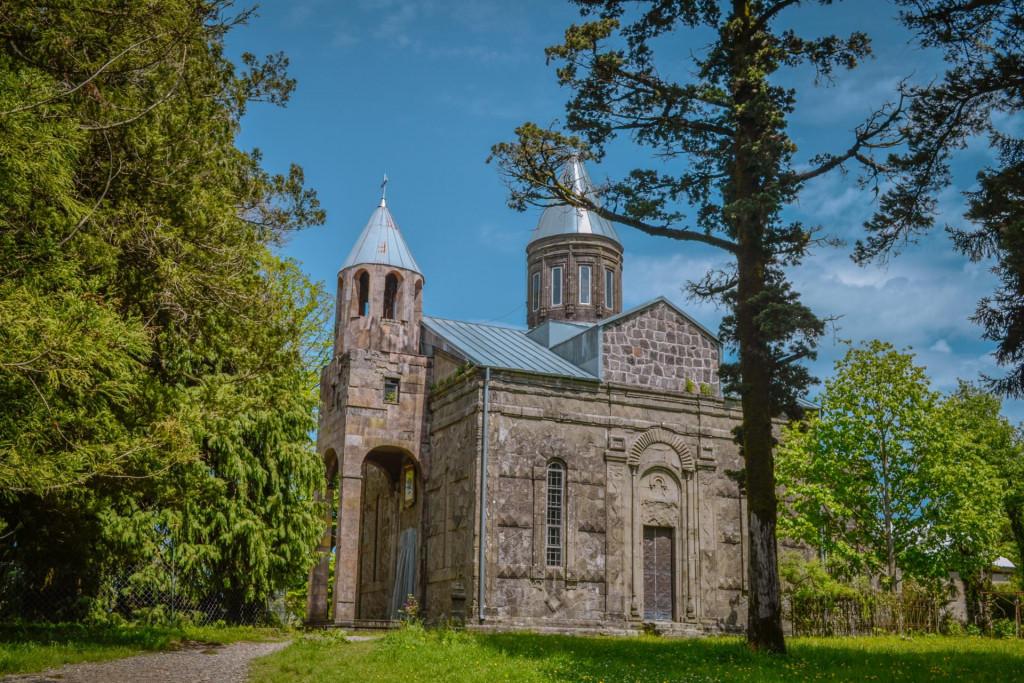
 The Sameba-Jikheti Church is a 19th-century landmark located in the Guria region, within the Lanchkhuti Municipality, situated between the villages of Chqonagora and Sameba. It currently functions as a nunnery.
Jikheti is located on the northern slope of the Guria Range, on Nigoyiti Mountain, at an elevation of 250 meters above sea level. It is 12 km from Lanchkhuti, 3 km from Nigoyiti, and 6 km from the main highway.
The Monastery Complex
The monastery was founded at the end of the 19th century.
- The Main Temple: The Temple of the Presentation of the Virgin Mary was built in 1896 by Ilarion Menabde of Ozurgeti.
- Bell Tower: Added to the main temple in 1987.
- St. George’s Church: A basilica-type church built in 1988.
- St. John the Baptist Church: Built in 2002, dedicated to the Conception of St. John the Baptist.
- The Jordan Spring: A baptismal pool in the courtyard fed by spring water. The water is believed to have medicinal properties.
Every year on December 4th, the feast day of the Presentation of the Virgin Mary, the monastery hosts a major celebration known as "Jikhetoba."
Legend
There is a legend regarding the location of the Jikheti Monastery. Originally, a monastery named after the Holy Myrrh-bearing Women stood in a very inaccessible spot on Jikheti Mountain. The nuns suffered greatly from a lack of water and decided to choose a new location. Following a tradition reminiscent of the biblical flood, they entrusted the choice to three doves. The new monastery was built on the spot where the doves finally landed.
History
It is believed that a fortress once stood on Jikheti Mountain, as the word "Jikha" means "fortress" in the Zan (Megrelian/Laz) language. Oral tradition suggests a church was built here during the reign of Queen Tamar, though by the 19th century, only ruins remained.
- 1886: Nun Elene Mgaloblishvili settled on the territory.
- 1893: The Machutadze noble family donated land to the nuns, and permission for construction was granted by the Holy Synod.
- 1896: Under the leadership of Ilarion Menabde, the stone Temple of the Presentation of the Virgin Mary was completed. Elene served as the Abbess from 1896 to 1914.
- Education: A school was opened at the monastery where literacy, domestic skills, and handicrafts were taught.
- Athos Connection: Historical sources indicate a close relationship with the Monastery of St. John the Evangelist on Mount Athos. In 1905, the Abbot of the Athos monastery, Hieromonk Iona, sent an icon of the Virgin Mary to Jikheti.
Tidings of the Jikheti Monastery
Christianity in this region dates back to the 1st century, preached by St. Andrew the First-Called. Later, a bishop from Western Georgia participated in the First Council of Nicaea.
While the modern structure is 19th-century, tradition links the spiritual roots to the 13th century and St. Queen Tamar. It is said she spent a night in prayer here during her travels in Adjara, and the local population built a small church in her honor. At the end of the 19th century, this spiritual legacy was transitioned to the Sameba Mountain site.
- 1905: The miracle-working Iveron Icon of the Mother of God, created on Mount Athos, arrived at the monastery.
- Soviet Period: Despite the hardships of the atheist era, liturgy never ceased in the temple—a success attributed to the protection of the Iveron Virgin Mary.
- Modern Additions: In 2011, the Church of All Saints Equal-to-the-Apostles was built using colored stones brought from all corners of Georgia.
- Museum: The monastery museum houses ecclesiastical items, personal belongings of the clergy and nuns, historical photographs, and vestments.
Today, the monastery maintains a small farm with livestock, orchards, and vegetable gardens. The nuns engage in various handicrafts. The complex also includes a skete and a guesthouse for pilgrims. Divine services are held daily.